
Toys Toys Everywhere
Puppy Toy Math Explained
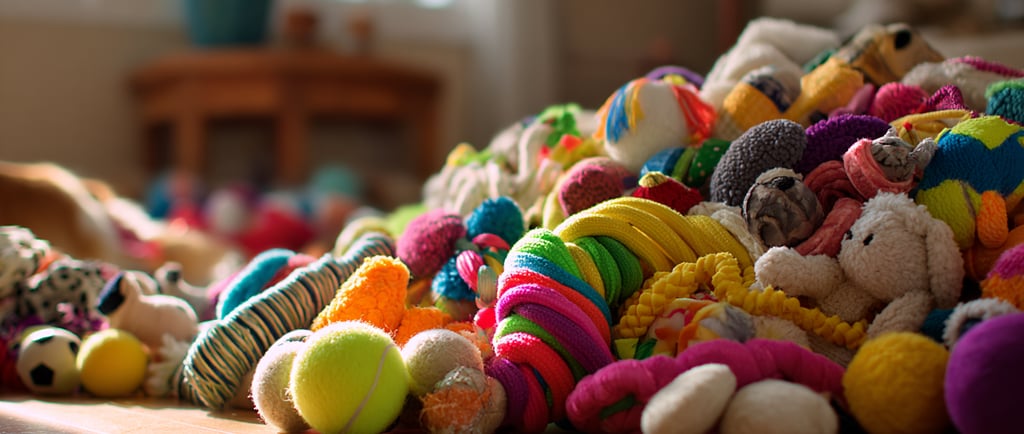
When we brought Bear and Abby home, my husband Bryan and I had a plan. A reasonable, responsible plan. Two puppies. A few toys. Done.
Reader, we have way too many toys.
I'm not entirely sure how it happened. Actually, I know exactly how it happened. And if you have a Labrador puppy — or are thinking about getting one — buckle up. Because Lab Puppy Math is a very real phenomenon and it will humble you.
What is Lab Puppy Math?
Lab Puppy Math is the phenomenon where a completely rational person (me) walks into a pet store for one bag of food and walks out with a rope toy, a squeaky hedgehog, a puzzle feeder, and a new collar — because the collar had their name on it and how could I not?
It follows a very simple formula:
The Official Lab Puppy Math Equation
1 Labrador puppy= 1
+ Those eyes when they look at you+ ∞
× Your willpower in a pet store× 0
= Toys in your living room= way too many
The conversation every Lab puppy household has
If you live with a partner, you already know this conversation by heart. In our house, it goes something like this:
Bryan says:
"They have enough toys. They don't need another one."
Crystal says:
"But this one is different. It crinkles AND squeaks. And Bear looked right at it."
Bryan says:
"Bear looks at everything."
Crystal says:
"...I'm getting it."
Bryan is not wrong. They do have enough toys. But here's the thing — Labs don't just need toys for fun. They need them for survival. Yours.
Why Labs actually go through so many toys
Labrador Retrievers were literally bred to carry things in their mouths all day. So when your puppy shreds a stuffed animal in 4 minutes flat, that's not bad behavior — that's four hundred years of selective breeding doing exactly what it was designed to do. Congratulations, you have a perfect dog.
"A bored Labrador is a destructive Labrador. A stimulated Labrador is a slightly less destructive Labrador who at least targeted the right object."
Bear and Abby together? Double the drive, double the toy casualties, double the joy. We've had squeaky toys last less than a morning. We've also had a simple rope toy survive six months. You never know what's going to become the beloved, indestructible favorite.
The actual toy categories you'll end up with
Every Lab household eventually accumulates the same collection. Here's the breakdown:
The Inevitable Toy Inventory
The Favorite (ignored for 3 weeks, then suddenly precious) just one
Squeaky toys (functional life: 8–45 minutes) too many
Rope toys (the cockroaches of dog toys) a lot
Puzzle feeders (enrichment! growth! stimulation!) more than needed
Stuffed animals (RIP to every single one) too many
Balls (rolling under couch permanently) so many
Chews and Kongs (the real MVPs) never enough
Random things that are NOT toys (socks, remotes, dignity) always 3
Total: way too many
So how many toys does a Lab puppy actually need?
Okay, setting the humor aside for a second — Labrador puppies genuinely do benefit from toy variety. Different textures satisfy different chewing instincts. Puzzle toys help tire out that massive Lab brain. Rotating toys (putting some away and swapping them out every few days) keeps things exciting without constantly buying new ones.
A solid starter set would include at least one good chew toy, one rope or tug toy, one ball, and one puzzle feeder. Everything after that is just for you. And that's okay.
Tips for surviving Lab puppy toy chaos
Rotate toys every few days — it's like new toys for free
Invest in indestructible toys early (save yourself the heartbreak)
Frozen Kongs are a game changer for rainy days
Accept that a sock will always be more interesting than anything you bought
Let dad think they have enough. Then add one more. He'll survive.
Bear and Abby have taught us that no number of toys is ever really "enough" — not because they're spoiled (okay, maybe a little), but because keeping a Lab happy and engaged is genuinely a full-time project. We're just doing our best.
Bryan has accepted this. Mostly.
labradorsociety@yahoo.com
© 2026. All rights reserved.